
Sasa Jātaka
The Hare Who Gave His Life
In the ancient times, when the moon was young and the stars shone brighter, there lived a noble hare, the Bodhisatta in a past life. He was no ordinary hare; his fur was as white as the driven snow, and his heart was filled with boundless compassion and generosity. He lived in a beautiful forest, surrounded by other animals, and he was beloved by all for his gentle nature and his willingness to help anyone in need.
The Bodhisatta, as this pure white hare, was particularly devoted to the practice of generosity. He would share whatever little he found – berries, roots, or tender shoots – with his friends. He believed that true happiness came from giving, from selfless acts of kindness that eased the suffering of others.
One day, the celestial being Sakka, the king of the gods, decided to test the virtue of the creatures on earth. He wished to see who amongst them possessed the purest heart, who truly embodied the spirit of selfless giving. To do this, he descended from his heavenly abode, disguised as a poor, old Brahmin, weak and famished. He wandered through the forest, his frail form trembling, his voice weak as he called out, "Alas, I am so hungry! Is there anyone, any kind soul, who can offer me a morsel of food? I have not eaten for days, and I feel my strength draining away."
The Bodhisatta, the white hare, heard the Brahmin's piteous cries. His heart immediately went out to the suffering old man. Without a moment's hesitation, he hopped towards the Brahmin, his white fur gleaming in the sunlight.
"Venerable Sir," the hare said, his voice clear and full of concern, "I have heard your plea. While I do not have much, I will gladly share what I have."
The Brahmin looked at the hare, his eyes filled with a mixture of weariness and hope. "Noble creature," he rasped, "I am so weak, I can barely stand. Do you have anything substantial to offer? Berries and roots are not enough for a man in my condition."
The Bodhisatta understood. He knew that for a human to gain strength, they needed proper nourishment. He thought for a moment, then his mind settled on a profound and selfless decision. "Sir," he said, his gaze unwavering, "I have nothing else to offer but myself. I am a hare, and my flesh, though perhaps not the finest, can sustain you. Please, take me. Cook me and eat me. It would bring me the greatest joy to know that my life has served to save yours."
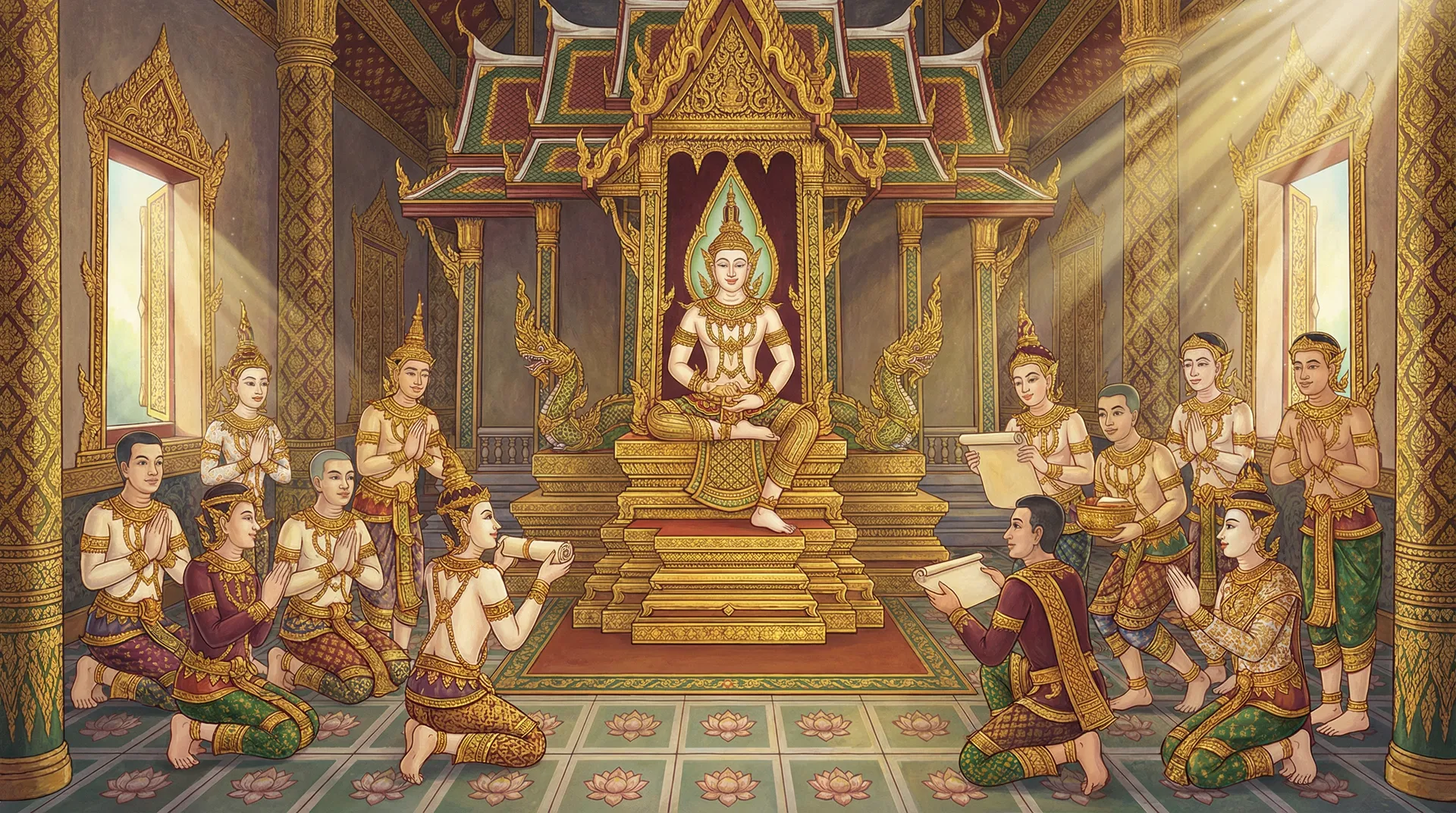
The Brahmin was astonished. He had tested many creatures that day – monkeys who offered him fruits, deer who offered him grass – but none had offered their very lives. He looked at the white hare, his pure eyes reflecting a love and compassion that transcended the physical. The Brahmin then revealed himself. He transformed back into the majestic form of Sakka, adorned in his celestial raiment, his divine presence filling the forest.
The other animals, who had gathered around, watched in awe. The Bodhisatta, the hare, remained calm, unfazed by the celestial revelation.
Sakka, his voice filled with immense respect, spoke to the hare. "Noble hare, your compassion and generosity are unparalleled. You have offered your life, the most precious gift one can give, without hesitation or reservation. You have shown a purity of heart that is truly divine."
Sakka then carefully gathered some grass and built a small fire. He prepared the hare, not as food, but as an offering of honor. He then took a large rock and, using his divine power, etched the image of the white hare onto its surface for all to see. This rock, bearing the imprint of the selfless hare, was then placed on the moon, so that its image would be forever visible to the world as a reminder of the Bodhisatta's supreme act of generosity.
Sakka then addressed the hare directly. "O most virtuous hare, your sacrifice will not be in vain. Your image will be etched in the moon for eternity, a testament to your boundless compassion. May all beings learn from your example and cultivate the virtue of selfless giving."
The Bodhisatta, having fulfilled his ultimate act of generosity, passed away peacefully, his spirit soaring with immense joy and satisfaction. His legacy, however, lived on. The image of the white hare became a symbol of compassion and selfless giving throughout the realms. Whenever people looked at the moon, they would see the hare and remember the profound lesson that true happiness is found not in receiving, but in giving, especially when that giving is of one's own life for the sake of another.
— In-Article Ad —
💡Moral of the Story
Selfless generosity, even to the point of sacrificing one's own life, is the highest virtue. True compassion extends beyond oneself and seeks to alleviate the suffering of others at any cost.
Perfection: Generosity (Dana), Compassion (Karuna), Truthfulness (Sacca)
— Ad Space (728x90) —
More Jataka Tales You May Enjoy
 513Vīsatinipāta
Kakkara Jataka
The Bodhisattva's Humble ServiceIn a time long past, in a kingdom blessed with fertile lands and a g...
💡 True value and grandeur lie not in outward displays of wealth and ornamentation, but in selfless service, practicality, and the well-being of others. Integrity and compassion are the highest forms of artistry.
72EkanipātaThe Golden Elephant Jataka
In a tranquil land, blessed with lush forests and a clear, flowing river, lived a herd of wild eleph...
💡 Wisdom is found in careful observation, unbiased listening, and the humility to admit one's mistakes.
 179Dukanipāta
Mahāpuṇṇa Jātaka
Mahāpuṇṇa JātakaIn the heart of the kingdom of Kasi, a land blessed with fertile soil and a prospero...
💡 By consciously pausing and reflecting when anger arises, one can gain control over impulsive reactions, leading to wiser decisions, improved relationships, and inner peace. Cultivating patience and understanding is a path to great merit.
14EkanipātaThe Bodhisatta as a Hunter
The Bodhisatta as a HunterIn the dense, untamed wilderness of the Himalayas, where snow-capped peaks...
💡 True compassion transcends self-preservation, and great sacrifices bring immeasurable blessings.
 274Tikanipāta
Muni Jataka
Muni JatakaIn the foothills of the Himalayas, where snow-capped peaks pierced the azure sky and anci...
💡 The greatest strength and truest conquest lie not in overcoming external forces, but in mastering oneself through inner peace, self-discipline, and wisdom.
258TikanipātaSutasoma Jātaka
Sutasoma JātakaIn the ancient city of Indapattha, a kingdom blessed with fertile lands and prosperou...
💡 True immortality is found not in the fear of death, but in the legacy of virtuous deeds and selfless sacrifice.
— Multiplex Ad —